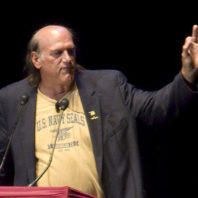
The Thomas S. Foley Distinguished Lecture Series is committed to spreading powerful ideas. Its purpose is to broaden the educational experience of WSU students and the surrounding community by bringing engaging and influential opinion leaders to campus in encourage thought-provoking discussions and ideas.
January 22, 2023
Watch on YouTube:
Bipartisan electoral reform and the 2024 election
Kim Wyman (Former Washington Secretary of State)
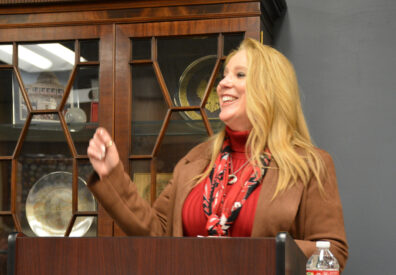
On Monday January 22, the Foley Institute hosted former Washington Secretary of State, Kim Wyman. Wyman began her talk by acknowledging that going into the 2024 election, the United States is living in one of the most politically polarized times in the nation’s history. She addressed the importance of our democracy depending on an honest, secure, and transparent election process. This, however, is at risk due to such polarization.
Wyman continued her talk by discussing the necessity of a seamless voting process. Emphasizing this point, she mentions early voting as a means for more individuals to cast their ballot despite their busy schedules. This will allow for a greater portion of individuals to participate in the 2024 election. She concluded by touching on the bipartisan support for voter ID laws so long as they are accessible to everyone financially and otherwise.
March 16, 2021
Watch on YouTube:
The crisis of democracy in global context
Kim Lane Scheppele (Princeton University)
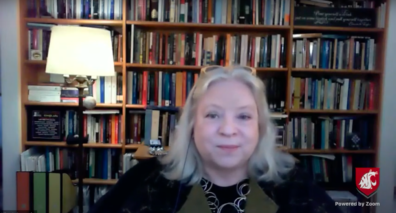
On March 16, the institute hosted Professor Kim Lane Scheppele of Princeton University for the final event of the Distinguished Lecture Series. Professor Scheppele discussed the global contexts of the January 6 crisis that shook the American democracy. She presented on this point by discussing the end of the Trump presidency within a broader global context.
To structure her discussion, Professor Scheppele noted the recent trend among some constitutional democracies towards instability and authoritarianism. To better understand this trend and the reasons for it, she first analyzed if democracies around the globe have been failing, and if so what the root causes of their failure is. She then talked about the potential role of populism in these declining democracies, such as Hungary or Poland. Then she offered another potential cause for the downturn in democracy—the changing role of political parties within democracies. Professor Scheppele stated that established parties have been weakened in recent years, where voters have no candidates they are enthusiastic about voting for. Furthermore, she notes that the collapse of the party system precedes democratic collapse. To conclude, Professor Scheppele evaluated the options available to alter this trend. She suggests that stronger parties need to reclaim their gatekeeping authority and offer better, vetted choices to voters.
March 4, 2021
Watch on YouTube:
The wayward course of American presidential democracy
Stephen Skowronek (Yale University)
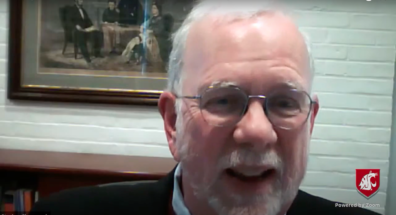
On March 4, the institute hosted Professor Stephen Skowronek of Yale University for the third event in the Distinguished Lecture Series on the crisis of American democracy. Professor Skowronek’s lecture discussed the impact of increased presidential power on the strength of the American democracy and government. To evaluate this, he focused on the institutional backstory to the issue, juxtaposing unitary executive theory with deep state conspiracy theories. He suggested that the institutional factors that contributed to the rise in these theories exist independently from the persona of the President.
Professor Skowronek situated the Trump presidency within the broader developmental and institutional contexts, noting the difference between the president as a manager or a mobilizer. He stated that the Trump presidency exposed potential problems intrinsic to the American presidency, such as balancing the president’s role as both a mobilizer and a manager, calling the current state of affairs ‘a beleaguered republic’. He continued by assessing differences between Trump and Biden in terms of their styles. He concluded with some suggestions about what might be done to correct the wayward course of the American presidential democracy, including a deliberate reconstruction of the mechanics of the government itself, which may include a departure from the text of the original constitution.
February 25, 2021
Watch on YouTube:
Is Trump a symptom of a Constitutional Dis-Ease?
Bruce Ackerman (Yale University)
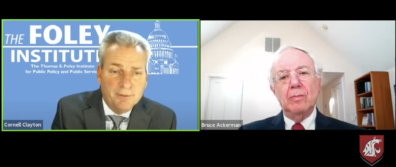
On February 25, Bruce Ackerman, Sterling Professor of Law and Political Science at Yale University, discussed the relationship between the US Constitution and the Trump presidency as part of the Foley Institute’s distinguished lecture series. He began the discussion with the second senate impeachment trial of former President Donald Trump. He acknowledged that the House impeachment managers recognized there was a second path to disqualifying former President Trump from office, namely the 14th Amendment. Ackerman noted that Section 3 of that amendment contains detailed and unambiguous language which says that any official of the United States government who engages in a conspiracy which involves an insurrection or rebellion against the constitutional foundations of the American government can be disqualified for further service. This procedure can be stopped if a two thirds majority of both houses of Congress grant the individual amnesty.
February 16, 2021
Watch on YouTube:
America’s constitutional crisis in historical context
Eric Foner (Colombia University)
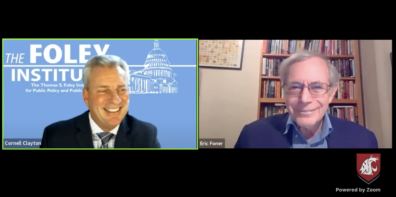
On February 16, Eric Foner of Columbia University delivered the first of a series of Foley Distinguished Lectures on the crisis in constitutional democracy that is currently facing the U.S. He suggested that our society is still working on the process of ending slavery, and that despite being abolished over a century ago, the Reconstruction Era has yet to end. He noted the parallels that exist between that time period and today, such as the violent attack on the Capitol and recent Supreme Court interpretations of the 14th Amendment.
Foner discussed how the ratification of the 13th, 14th, and 15th Amendments were fueled by anti-slavery constitutionalism which separated the concept of citizenship from race. He noted that popular constitutionalism occurred as discussion about what exactly rights and nationality meant in relation to black suffrage. At that time, it was common that people debated concepts of rights and citizenship of African Americans outside of lawmaking such as within churches, public journals, and households.
Foner concluded by discussing how white supremacists overthrew Reconstruction as seen in 1898 in North Carolina and how the next generation dealt with a Jim Crow system that fundamentally undermined the pursuit of a higher quality of life by destroying black education, taking away the right to vote, rigging the labor markets that reserved the best jobs for white people, violent murders, lynching, and racist acts within policing. He pointed out that while Congress attempted to enforce the 13th, 14th, and 15th Amendments, the Supreme Court diluted these protections.
March 10, 2020
Middle East meltdown: Causes and consequences
Ryan Crocker, (Former Ambassador for the United States)
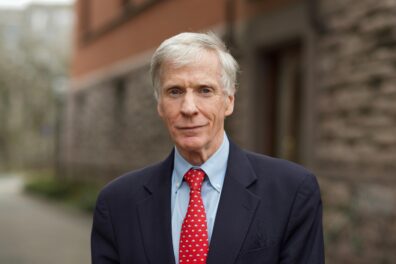
On March 10, Ryan Crocker, a former Ambassador for the United States to Afghanistan, Iraq, Syria, Kuwait, Lebanon, and Pakistan, spoke about failed states in the Middle East.
He explained that when states fail, political actors move towards the “empty space” to seize power and gain control. One of the problems was, he suggested, that colonizing countries such as France and Britain were not interested in building democratic institutions and laws, but rather to enrich themselves. After the failure of colonialism, a political vacuum gave way to the fall of monarchies in the Middle East. Arab Nationalists rose to power in countries such as Egypt, Iraq, and Libya. Militaristic leaders such as Khadafi ascended to power in Libya, Communism in Yemen, and Arab socialism is Syria and Iraq.
Crocker argued that elections alone do not create a democracy. The creation of democracy requires institutions and laws for the people of a state to self-govern, before figuring out election processes. While states with the most power strive to remake the world to advance their own interests, democracy requires interests of the people as well. Essentials of democracy include security, economic opportunity, social services, and individual liberties.
In 2014, the Islamic State demanded a lot of US attention. A difference between the Islamic State and prior regimes was that they understood the importance of governance. Crocker stated there was evidence that suggested the Islamic state knew how to provide the needs of the people that previous regimes failed to provide such as a desire to have authentic governance.
In the summer of 2014, the Islamic state sent delegations into hospitals to learn how to provide services. The delegation asked the hospital staff about information on medical inventory, nurses, doctors, and medical qualifications. The Islamic state understood the historical legacy and tried to show they were going to govern in a style that helped the people. However, the Islamic states extremism and the United States military pressure led to the Islamic state’s collapse. In the future, ungoverned space provides opportunity for Islamic state to possibly return, if not the Islamic state then another group will rise to govern.
October 8, 2019
Authoritarianism and democracy in America
Steven Levitsky (Bestselling author of How Democracies Die)

On Wednesday October 9, Harvard Professor Dr. Steven Levitsky spoke at the Foley institute about the emergence of far right-wing movements in Latin America and how economic fluctuations and crime have shifted power between the moderate left and right wings over the last three decades.
Levitsky explained that poverty and inequality in Latin America laid the groundwork for political instability before and during the Cold War. After the Cold War, coups in Latin America became less common and democracy was slowly able to emerge in several regions. Between 2000 and 2012 Latin America saw a major rise in its exports allowing many countries to increase their budgets for popular social programs. However, satisfaction with moderate left-wing parties began to dwindle as economies stagnated. In combination with corruption and high crime, this has led many to shift their support to far right wing parties in hopes that they will fix the problem. While this shift hasn’t been as large as many expected, more far right parties could emerge if moderates don’t deliver on their promises.
April 25, 2019
Foley distinguished lecture: Constitutional crises, real and imagined
Keith Whittington (Award winning author and professor of politics at Princeton University)
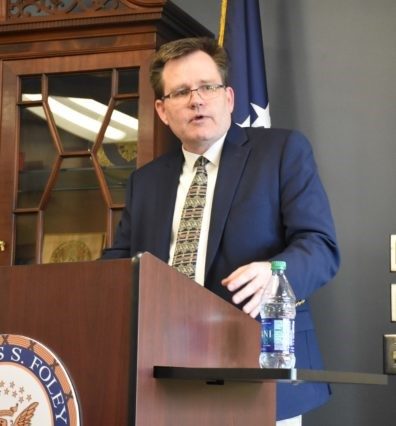
On Thursday April 25, Keith Whittington, award winning author and professor of politics at Princeton University spoke at the Foley Institute about what scenarios qualifies as a constitutional crisis and how the U.S has dealt with them throughout history.
He first describes what constitutes a crisis of operation, meaning that the constitution no longer applies in our actual politics. The constitution is supposed to direct our political disagreements in a meaningful way that stays within the bounds of constitutional literature. However, during a crisis of operation the constitution may not prescribe a solution to our real world issues, and this may undermine the entire constitution depending on the weight of the problem. A crisis of fidelity applies to situations when we no longer want to follow constitutional pronouncements. This can occur for many reasons. One example he gives is the Garrisonians who thought the entire constitution was immoral due to slavery and could not be reconciled in a constructive way. Our current constitutional crisis lies within our inability to compromise on our political disagreements when the constitution was made to foster constructive compromising. He ends by emphasizing the dangers of political polarization and the need to combat the issue so we can safeguard our constitutional system.
March 28, 2019
Public Lecture: The NCAA money race. Can it be stopped?
Andrew Zimbalist (Nationally renowned sports economist)
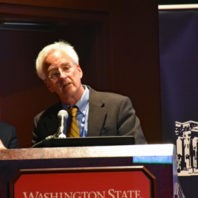
On Thursday, March 28, nationally renowned sports economist Andrew Zimbalist discussed the way we finance college sports and the effects on universities.
February 19, 2019
Distinguished Lecture: The politics of carbon tax
Aseem Prakash (Director of the University of Washington’s Center for Environmental Politics)
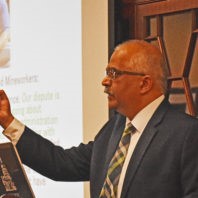
On Tuesday February 19, professor and director of the University of Washington Center for Environmental Politics, Aseem Prakash spoke at the Foley institute about the politics of a carbon tax. The lecture focused on why areas such as Washington and France have rejected carbon related initiatives and how we can effectively move forward towards improving these polices.
Dr. Prakash offered that the way to combat climate change and normalize carbon tax initiatives requires a change in our dialogue and perceptions regarding the issue. He explained there is often a misconception held by the public that carbon taxes serve the elite and punish the average citizen. However, even the revenue positive 2018 carbon tax initiative 1631 failed with voters in both eastern and western Washington. Polling also suggests that climate change is not a very popular issue for voters across the board. He suggests that in order to combat these problems, individuals need to take responsibility for their consumer choices.
October 4, 2018
Public Lecture: Fantasyland
Kurt Anderson (Best-selling Author of Fantasyland: How America went Haywire.)
On Thursday, October 4, Kurt Andersen, a distinguished author, discussed key aspects within his best-selling book, Fantasyland: How America went Haywire.
Andersen’s perception of America’s four-hundred year history led him to conclude his view that there is a strong connection to subjective beliefs and feelings over empirical and factual truths. As a result, a delusional set of beliefs have gained sway in the U.S., making Americans appear to hold more extreme views, and believe more fake news than the rest of the Western World. Throughout his lecture, connections between historical, as well as current, examples of extreme religious views, intense individualism, conspiracy theories, and a show business mentality are claimed as contributions to the formation of Fantasyland America. Andersen argues that Americans can still regain their national balance despite a long and recurring history of fantastical thinking, which has led to an imbalance of political polarization.

April 9th, 2018
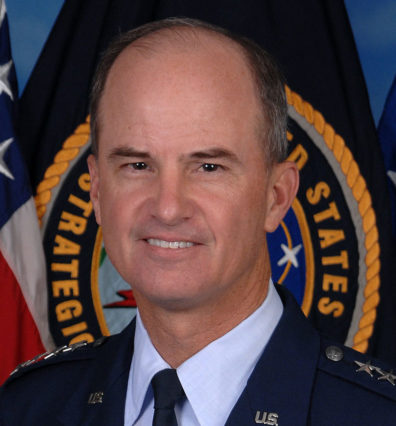
U.S. nuclear weapons: What are they good for?
General Kevin Chilton, (U.S. Air Force, Ret.)
General Kevin Chilton, (U.S. Air Force, Ret.), who spoke about America’s nuclear deterrence capabilities. Recalling that there has not been a major war since nuclear bombs were dropped on Japan at the end of the Second World War, Chilton made a forceful case for the need to maintain and improve the arsenal of nuclear weapons in the United States. He suggested that it was important keep pace with potential enemies in the world, given the increasing proliferation of nuclear arms despite numerous treaties.
Chilton went on to say that the best approach for an army is not to fight a war, but to prevent one from taking place, and that failing to do so could easily lead to the end of our country and way of life as we know it.
March 29, 2018
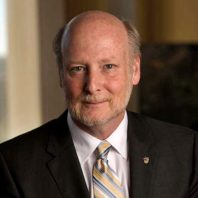
Free Speech and Campus Climate Issues
Howard Gillman is chancellor of the University of California Irvine. His most recent book (with Erwin Chemerinsky) is Free Speech on Campus, which offers some perspective around what colleges can and cannot do when dealing with free speech controversies.
March 28, 2016
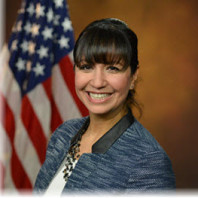
Criminal Justice Reform: Can scientific research help us?
Nancy Rodriguez (director of the National Institute of Justice)
October 2, 2014
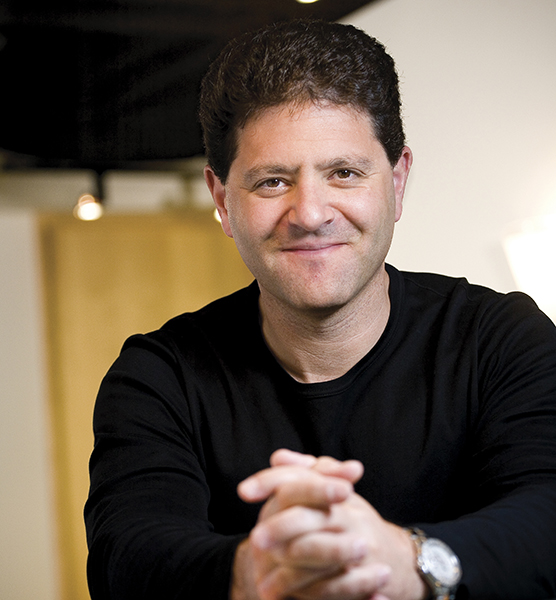
$aving American Capitalism: Inequality in America
Nic Hanauer (venture capitalist) gave two Foley Distinguished lectures: one on the WSU Pullman campus, and another at the Fox Theater in Spokane, WA. Hanauer, an entrepreneur, civic activist, philanthropist, education advocate, and member of the 1%, argued that the economic status quo of the United States and the shrinking middle class is a detriment to everyone—including the very wealthiest. Successful capitalism, he argued, is the greatest social technology ever invented to create prosperity in human societies, but when left unchecked, leads to concentration of capital and eventual collapse. Instead of a trickle-down approach, we need to refocus our efforts to strengthening the middle class. He called for a change in the way all Americans see our economy, and how wealth is distributed.
October 11, 2009
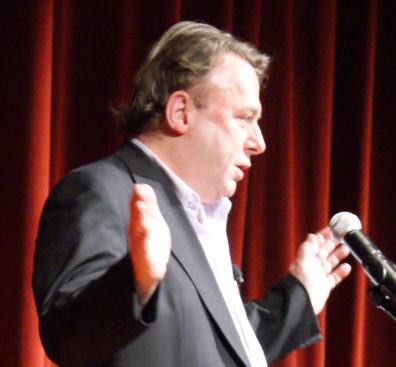
Religion & Politics: The Place for Religion in Public Life
Christopher Hitchens (political commentator and writer) visited Pullman in October 2009 to present an evening lecture on the subject of “Religion and Politics: The Place for Religion in Public Life”. Speaking to an audience of almost 500, his lecture provoked a thoughtful dialogue with audience members during an extended question and answer session.
Hitchens expounded on the thesis that his audience was lucky to live in a country like America, one of the few countries of the world with a defined separation of church and state. He discussed some of the problems inherent in countries that allow religion to dominate politics, although he did also note that one way to ensure a more secular country is to institute a state religion, as is the case in the United Kingdom. Following his speech, Hitchens signed copies of his book and met with members of the audience.
The following day, Hitchens met with students, faculty, and others as part of our Coffee and Politics series. He addressed a wide range of topics including the political situation in Cuba, the re-emergence of the political Left in Latin America, the Israeli-Palestinian conflict, and Afghanistan. Christopher Hitchens’ most recent book is entitled God is not Great: How Religion Poisons Everything.
April 15, 2009
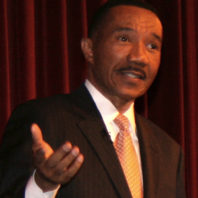
Race, Class and Economic Recovery in Obama’s America
Kweisi Mfume (activist, former Congressman, former head of the NAACP)
March 19, 2013
The Era of Political Instability
Renowned scholar, professor of Political Science at Stanford University, and political commentator Morris P. Fiorina will discuss what the 2012 election means in historical context.

September 24, 2009
Empire of Illusion: The End of Literacy and the Triumph of Spectacle
Author Chris Hedges discusses his latest book, Empire of Illusion: The End of Literacy and the Triumph of Spectacle, followed by a book-signing. 7:00 p.m., CUB Auditorium.
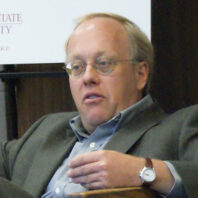
April 12, 2006
National Security and Civil Liberties in the 21st Century
John Ashcroft (Former Attorney General) presents “National Security and Civil Liberties in the 21st Century.”
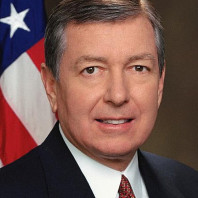
March 28, 2005
3rd Annual Foley Spring Public Affairs Lecture
Howard Dean
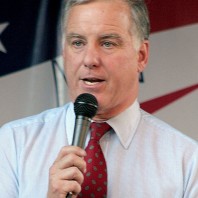
October 29, 2004
Jesse Ventura (Former Governor of Minnesota)