August 27, 2024 – Public Lecture
David Lublin: “Welcome to the 2024 Election!”
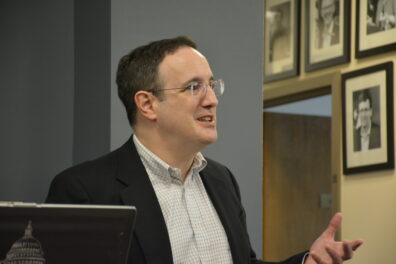
On August 27, the institute hosted David Lublin, who spoke on the state of our political parties, their functionality, and the trends of heightened partisanship over the past decade.
During his presentation, Professor Lublin joked that political parties “disagree because they disagree,” and then offered explanations for the growth of polarization we are witnessing. His examples include echo chambers created by social media, gerrymandering which results in malapportioned districts and disproportionate representation, and broader issues with our current electoral system.
He then went on to introduce state initiatives to decrease polarization via a four-tier rank voting system, wherein candidates would be ranked by voters, and the candidate with the highest percentage of support after multiple rounds of voting would be elected, supposedly resulting in the candidate with the broadest favorability among the electorate.
Lublin concluded his talk by giving examples of elections in which the four-tier ranking system was utilized, and how that process was facilitated. He compared these results to typical election outcomes, showing that the four-tier ranking system was effective in achieving more representative outcomes. He then fielded a variety of questions regarding partisanship and voting processes, such as the role of Citizens United (2010) in party politics and what a post-Trump Republican Party might look like.
David Lublin is Professor and Chair of the Department of Government in the School of Public Affairs at American University. He recently co-led the American Political Science Association’s task force’s report More than Red and Blue: Political Parties and American Democracy.
September 3, 2024 – Public Lecture
Liz Howard: “Election integrity”
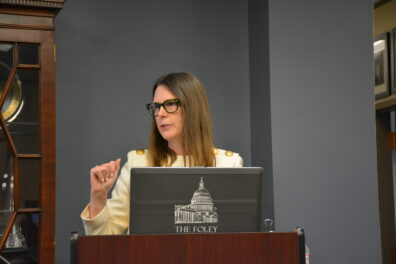
On September 3, the Foley Institute hosted Liz Howard, The Brennan Center for Justice at New York University School of Law, who spoke about how recent challenges have distorted public perception regarding the reliability of election administration and what can be done to reassure voters and restore faith in our democratic processes.
Ms. Howard began her speech by addressing the need for increased election security in the post-2020 political climate. She discussed violence and threats of violence against election officials and explained how their safety has become more of a concern in recent years. Shockingly, she said, most of these threats were reported as happening in person or over the phone, rather than through social media. She went on to provide scenarios in which Artificial Intelligence and the spread of misinformation could impact election results; generating a false AI video of herself proving the ease and accessibility of creating such disinformation.
Howard concluded her talk by imploring the public to be active and responsible advocates for election integrity. She emphasized that when using social media, it is important to rely on trusted sources and to think before reposting.
Liz Howard is Director of Partner Engagement with the Elections and Government Program at the Brennan Center for Justice.
September 10, 2024 – Public Lecture
Pavielle Haines: “Presidential rhetoric”

On September 10, The Foley Institute hosted Pavielle Haines, University of Idaho, who was talking about patriotism in American politics.
Professor Haines discussed the meaning of patriotism within the context of each political party and explained how its use has historically been more beneficial to the GOP, who claimed to be the patriotic party, and as a result, was able to control the definition. By maintaining ownership over the concept of patriotism, Republicans have been able to shape it in their image and gain electoral advantages by invoking a sense of national identity. She elaborated on this by describing how Trump has used patriotism to construct the narrative that “real Americans” must build defenses against alleged cultural threats.
Haines concluded her presentation by discussing how Donald Trump’s rhetoric is fundamentally changing the meaning of patriotism and thus the Republican party’s platform. Democrats are using this transitional period to close the patriotic credibility gap; recent polls have shown that it is shrinking as Harris leans into the idea of patriotism as a unifying and inclusive term. While it is hard to predict whether Harris’s patriotic messaging will garner her more votes, Dr. Haines emphasized that the effort can only benefit the Democratic party.
Pavielle Haines is an assistant professor of political science at the University of Idaho. Specializing in American politics, identity politics, political behavior, and the presidency, Dr. Haines’s research was awarded the Best Dissertation in Political Psychology by the American Political Science Association in 2019. She has published in journals such as American Political Science Review, Perspectives on Politics, and Political Research Quarterly. Her current work examines how presidential candidates use patriotic rhetoric to shape public attitudes about who “counts” as an American.
September 17, 2024 – Public Lecture
Seth Masket: “The GOP’s view on past and current elections”
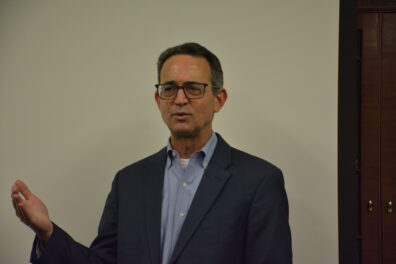
On September 14, the Foley Institute hosted Seth Masket as he spoke on the future of the GOP.
Professor Masket began by identifying Trump as the inheritor of a conservative populist tradition in US politics, citing his strong anti-immigration rhetoric, conspiratorial views, and authoritarian legal beliefs. Following this, Masket introduced his research about candidate support among republican party chairs.
His polling revealed that Trump was not presumed to be the presidential candidate until his contemporaries failed to match his media presence. Trump dominated the conversation during Republican debates, overwhelmingly commanding the Fox News airtime. This, paired with an indictment that led to a perception of martyrdom, gave Trump the momentum needed to secure the nomination. Many Republican chairs cited this persecution as their reasoning for defending and supporting Trump, as they felt he was being unfairly treated by both the media and legal system.
Masket concluded his talk by stating that Trump’s nomination was never really in doubt, and that county chairs are mostly reflecting the will of their constituents. He emphasized that what once distinguished Trump supporters from others, a conservative populist message and world view, is now the majority faction in the party. In this way, Trump has successfully reimagined the Republican Party in his image.
Seth Masket is a professor of political science and the director of the Center on American Politics at the University of Denver. He is the author of Learning from Loss: The Democrats 2016-2020 (Cambridge, 2020), The Inevitable Party: Why Attempts to Kill the Party System Fail and How They Weaken Democracy (Oxford, 2016), and No Middle Ground: How Informal Party Organizations Control Nominations and Polarize Legislatures (Michigan, 2009), as well as a co-author of a recent textbook on political parties. He studies political parties, campaigns and elections, and state legislatures. He contributes regularly at Politico, Mischiefs of Faction, and the Denver Post. He is currently working on a book project examining the Republican Party’s interpretations of the 2020 election and its preparations for 2024.
September 24, 2024 – Public Lecture
Lilliana Mason: “Radical partisanship”
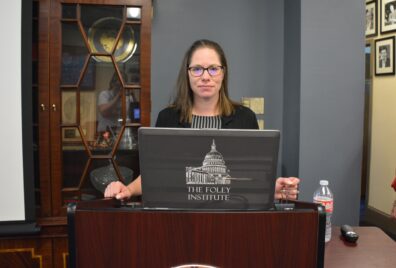
On September 24, the Foley Institute hosted Lilliana Mason, who spoke about radical partisanship in the United States.
Professor Mason began by highlighting the importance of social sorting by identity and place, and discussing how these groupings influence our politics. She then shared how these groupings play into “us versus them” ideologies, and manifest into party beliefs. She discussed moral disengagement by party and how political violence is justified by one side seeing the other as a threat, evil, or even non-human. She then discussed how trends of violence increase during times of political turmoil, such as around indictments. She pointed out that most violence in actual practice comes from the far right. Her data revealed that there is a large rift with the Republican party. Perpetrators of political violence, as shown by recent data, are overwhelmingly 2020 election deniers; moderate Republicans are far more likely to be tolerant and passive.
She concluded by suggesting that anti-violent messages from leaders can reduce violent views. She discussed the normalization of violence, and how people are less likely to be in favor of political violence when reminded of anti-violent social standards. Going forward, she said, it is important to identify and prioritize pro-pluralist conservative voices, encourage sub-identities that counter the anti-pluralistic movement, and enforce anti-violent norms in communities.
Lilliana Mason is SNF Agora Institute Associate Professor of Political Science at Johns Hopkins University. She is co-author of Radical American Partisanship: Mapping Violent Hostility, Its Causes, and the Consequences for Democracy.
October 8, 2024 – Public Lecture
James Curry: “Congress”
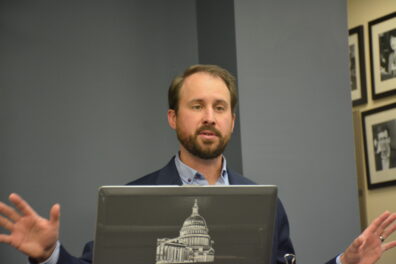
On October 8, the institute welcomed James Curry back for a discussion about the likely makeup of the 119th Congress, as well as its potential for passing legislation.
Professor Curry began with a discussion of the upcoming races in the House and the Senate, noting that the Senate would be very likely to see a Republican majority, as the Democrats have more seats to “defend”, and the Republicans have an inherent advantage due to noncompetitive seats, as well as the holding of seats not currently up for election. Among the seats that are even marginally competitive, Curry predicted that Republicans would win a majority even with a relatively poor electoral performance, while the Democrats would have to perform unrealistically well to see a majority.
He went on to predict divided government, with the Democrats winning a majority in the house, suggesting that this is due to many of the open house seats being in Democrat-leaning states and districts, in addition to an expected bounce-back performance relative to the 2022 midterm elections. A generic house ballot poll also had the Democrats with a two-point lead, similarly to a poll during the 2022 midterms, which accurately predicted the narrow Republican victory.
Curry spent the second half of his talk discussing partisan policy agendas. He noted that while polarization has grown, the policy process has actually seen little change over time, with compromise being as prevalent as ever. This is supported by the fact that since 1985, only 4% of major partisan agenda items have been passed which could be considered “big wins”, even though Congress is popularly viewed as highly divided and uncooperative. Additionally, while the sheer number of bills passed has declined over time, the size and breadth of bills passed has increased significantly, indicating that the same amount of policy is still being passed—it is rather being concentrated into fewer bills. Curry’s main argument was that while election platforms may seem dramatic, the reality of Congress and policymaking is generally constrained to a more reasonable scope.
James Curry is an associate professor of political science at the University of Utah.
October 15, 2024 – Public Lecture
Kathleen Searles: “Media and politics”
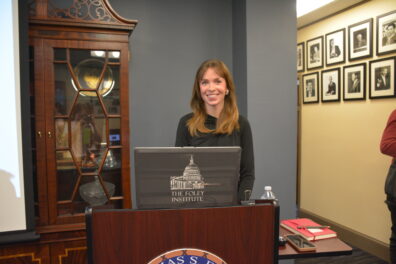
On October 15, the Foley Institute was pleased to welcome Kathleen Searles, Olin D. Johnston Chair of Political Science at the University of South Carolina, to speak on the subject of media and politics and the election. In his introduction, Professor Clayton welcomed Katie back to WSU, from where she received her Ph.D. in political science in 2011.
Professor Searles’ talk opened with a discussion around what the public get wrong about the news media. She pointed out that one of the biggest issues she faces in her research is that everyone claims to understand what the news media is and how it should operate. Common criticisms of the news media are that they do a poor job of explaining and encouraging democracy, and of being too biased. In addressing these points, Searles explained how the media actually works to educate the public about democratic processes and how some levels of bias are to be expected, given that bias is a part of human nature. She suggested that there is an expectation for news to be entertaining, produced in the United States by privately owned companies that assume that the general public does not want to consume politics that is produced in a pedestrian manner.
She went on to explain what the news media gets right. Despite the negative sentiments surrounding them, horse race polls can be a good and informative way for the public to receive a general synopsis of the current state of the election in a quick and easy-to-understand format. Searles also gave examples of how the news media has changed in the past to aid in the democratic process. One such example from her research was the finding that using images of long lines in election articles for example discouraged voting. She noted that when this study was presented to the news companies, long line images began to be removed, and she noted that there was a higher election turnout in 2022.
Searles has co-authored two books with Oxford University Press and Cambridge University Press and has been awarded more than 7 million dollars in grant monies, including 4 National Science Foundation grants. She is the co-Pi of Expert Voices Together and a founding member and executive emerita of Women Also Know Stuff. She is a co-convener of the Election Coverage and Democracy Network, which works with journalists to cover electoral politics.
October 22, 2024 – Public Lecture
Stuart Elway: “WA races and polling”
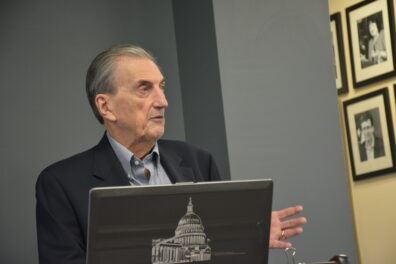
On October 22, the Foley Institute hosted pollster Stuart Elway, who spoke about Washington state elections and partisan politics in the Evergreen State.
Elway began his talk by providing a history of party preference in Washington, detailing preferences in presidential, gubernatorial, and state office elections since 1968. He explored the wide-held belief that Washington has always been a blue state dominated by democratic influence, and how this was not necessarily the case.
He discussed “The Big Sort,” which is a phenomenon of people moving to be surrounded by others in political agreement and, in doing so, create single-party counties. Elway then talked about how this is exemplified in Washington state on either side of the “Cascade Curtain” and discussed how the effect has perpetuated polarization and the demonization of political adversaries. In particular, he noted, this has transformed urban areas in Washington into densely democrat-populated districts, diluting the voting power of Republicans in the state. Elway noted that this has resulted in a state-wide shift towards democratic control from local government to senators and representatives.
Elway concluded his talk by looking towards the 2024 election and predicted a near sweep for democrats in the Washington state races. He also discussed the presidential election with reference to the predicted closeness of the likely outcome, and the impact that it might have on the future of our democracy.
Stuart Elway has been conducting public opinion research since 1975 and currently directs the Cascade PBS/Elway Poll.
October 29, 2024 – Public Lecture
Emily LaRosa: “AI and campaigns”
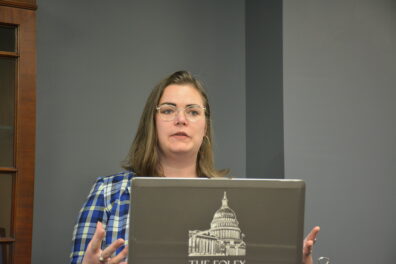
On October 29, the institute welcomed Emily LaRosa for a discussion about Artificial Intelligence (AI) and its use in political campaigns.
LaRosa began with a technical overview of what constitutes artificial intelligence, in addition to how the technology could be most effectively utilized. She suggested that AI is best used as a data analysis tool rather than an arbiter of decision making. She also presented an overview of different applications for AI, given that it is increasingly being used as a catch-all term used to describe various technologies.
She then discussed applications of AI specific to political campaigns, especially in campaign management and advertising. This can take the form of assisting in ad targeting and content creation as well as for internal uses such as for general decision making for a campaign.
LaRosa also covered past uses of AI in political campaigns, from Obama’s 2012 campaign through to the Trump and Biden campaigns, where all three used AI to target voters. Such uses bring about numerous ethical dilemmas, particularly around data privacy for nonconsenting consumers, and a more normative question around the issue of manipulating individuals’ opinions.
She concluded with some possible solutions for those ethical concerns, suggesting that increased regulations, transparency, and accountability as the most effective approach. Given the power of AI, there is the potential for substantial misuse, requiring comprehensive legislation to protect consumers and incentivize actors to behave morally. She noted that the issue is similar in nature to data privacy with respect to big tech and should be approached similarly and that it will be important to establish legitimacy and trust as AI becomes increasingly entwined in our daily lives.
Emily LaRosa is a doctoral candidate at Michigan State University.
October 31, 2024 – Public Lecture
Scott Lemieux: “The Supreme Court and the election”
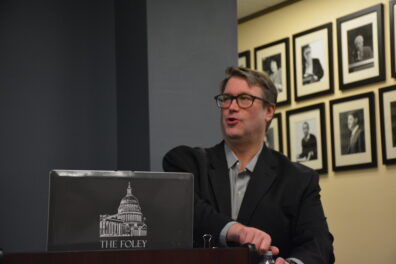
On October 31, the institute hosted Scott Lemieux for a talk about Supreme Court politics in light of the potential incoming administrations.
Professor Lemieux began with an overview of the ideological leanings of the current court in the context of the current polarized political environment. He argued that such polarization increases the stakes of Supreme Court nominations, as ideological divisions have only recently turned into distinct partisan divides. Prior to these recent changes, he suggested, polarization among political elites was relatively weak, resulting in only occasional misalignment between the partisan leanings of the nominating president and their respective justices. He illustrated this point using the makeup of the 1988 Supreme Court. Justice Brennan, despite being an Eisenhower nominee, was at the heart of the liberal Supreme Court bloc, while Justice White was nominated by John F. Kennedy, yet generally remained in the more conservative bloc.
Lemieux discussed changes in Supreme Court confirmation voting. Justice confirmations used to be nearly unanimous, with 90+ votes in favor being commonplace. These margins have declined significantly over time, with all four of the most recent nominations being confirmed with under 55 votes. The norm has shifted to the nominating political party voting in unison, with only a few votes (if any) coming from the opposite party. As a result, the emphasis on credentials from an objective perspective has declined over time.
Lemieux closed the presentation by discussing numerous scenarios following the presidential election. He predicted that if Trump were to win, the current 6-3 court (which leans Republican) will likely be a partner, rather than a check, on the Trump administration. Additionally, there will likely be strategic retirements within the court to ensure a Republican majority for the foreseeable future. He felt that a Harris administration would have a difficult time achieving a Supreme Court nomination given the likelihood of a Republican majority in the Senate, resulting in a likely continuance of the status quo.
Scott Lemieux is an Associate Teaching Professor of Political Science at the University of Washington.