September 4, 2025 – The Future of Liberal Democracy Series
Gary Gerstle: “Neoliberalism and the changing political order”
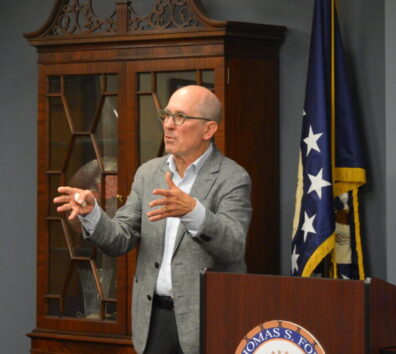
On September 4, the Foley Institute hosted Gary Gerstle, from Harvard University, who spoke on how the neoliberal order rose and fell in American politics and where the resulting ideological shift may take us in the future.
Professor Gerstle began his presentation by addressing the concepts that underlie a political order and neoliberalism. He explained that a political order is the pattern of policies and political ideologies that endure beyond election cycles, typified by the political orders of the New Deal under Franklin Roosevelt and neoliberalism, championed by former president Ronald Reagan. Neoliberalism distinguishes itself from conservatism by the desire to disrupt tradition and dismantle the institutions that support it.
Tracing the rise of neoliberalism, Gerstle suggested that the fall of the Soviet Union and the resulting delegitimization of their communist ideologies ushered in a more dominant era of that political order. Gerstle highlighted that without a competing communist interest, there was no need for American leaders to compromise between the interests of the elites and the working classes. Further, the fall of the Soviet Union opened up a large part of the world to capitalism.
However, the influence of neoliberalism began to wane due to the enormous inequalities that resulted, and Gerstle noted that the 2008 financial crisis left millions of Americans frustrated, in despair, and especially angered by the failure to hold those responsible accountable. Donald Trump ignited the flame left in the wake of the financial crisis and became the most important political figure in America and the world.
Gerstel argued that in some ways, Trump upheld the values of neoliberalism through his tax cuts and deregulation of industry. However, given the assault on free trade and the targeting of both illegal and legal immigration, Trump era policies facilitated the undoing of the neoliberal order.
Professor Gerstle then discussed the current direction of American politics. He said it is unclear if Trump will succeed in establishing a new political order, as that requires expanding his base, which he has been seemingly reluctant to do. Gerstle suggested the actions of Trump have not been consistent with those of Roosevelt or Reagan as they designed their respective political orders, but rather like those of dictator Viktor Orbán of Hungary. Gerstle concluded by stating that a democratic path to the 2026 elections is dependent on how we, as a citizenry, care to preserve the legacy of our forefathers.
Gary Gerstle is the Paul Mellon Professor of American History Emeritus at the University of Cambridge and a Visiting Scholar at the Harvard-Radcliffe Institute, Harvard University.
September 11, 2025 – The Future of Liberal Democracy Series
“Deconstructing the deep state” with Jefferey Kopstein
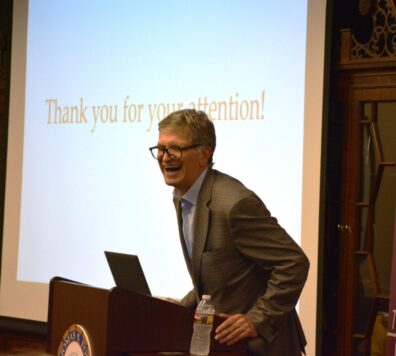
On September 11, the Foley Institute hosted Jefferey Kopstein, who discussed populist complaints of the “deep state.”
Professor Kopstein opened his presentation by addressing the impact of COVID-19 on public health policies, highlighting individuals’ inability to agree on policies in highly developed countries such as the United States. He suggested the inability to adopt policies is one symptom of a larger assault on the modern state. He then noted public opinion today shows that 50% of Americans believe in something called the deep state.
Kopstein then shifted attention to the origins of the deep state myth, touching upon the 1996 Susurluk scandal in Turkey. This scandal revealed the exitance of a deep state in Turkey which was a collision of officials and organized criminals operating within the Turkish State. He discussed how the concept of the deep state then extended to other countries in the Middle East and eventually the United States. Kopstein addressed the importance of defending the modern state from assaults upon it, noting pre-modern states’ inability to handle challenges of modernity, such as modern war, regulating capitalism, and climate change.
Pivoting the discussion, Kopstein touched on democracy, patrimonialism, and regime typology. He discussed global examples relating to the deep state, including Israel’s consideration of reconstructing the civil service. Ultimately, relating back to the United States under the Trump administration, Kopstein highlighted Schedule F, which reclassified civil servants to allow for certain policy-oriented positions. Kopstein noted that without the modern state, our air would be poisonous, our water undrinkable, and our food inedible. In conclusion, he noted that we are in a demolition phase, and that our state will be replaced by a repurposed patrimonial state. As a result, there is no guarantee that just because we want a modern state, we will be able to get it.
Jeffrey Kopstein is Dean’s Professor of Political Science at the University of California, Irvine. His latest book is The Assault on the State: How the Global Attack on Modern Government Endangers Our Future, published in 2024.
September 16, 2025 – The Future of Liberal Democracy Series
“Democracy and open elections” with Steve Hobbs, Steve Vuleta, and Laura Arce

On September 16, the Foley Institute hosted Steve Hobbs, Steve Vuleta, and Laura Arce, who discussed democracy and open elections, with an emphasis on the electoral process in Washington State.
The discussion started by highlighting the threats to the electoral process. Hobbs opened the comments by noting the involvement of nation-state actors such as Russia, China, and North Korea, in addition to violent extremist groups amplifying misinformation on the internet around election. He went on to discuss the rising risk of physical and cyber threats to the electoral infrastructure. Then, the Secretary of State’s team proceeded to reveal the measures taken to ensure election security. These measures include a multi-step process for signature verification, ballot reconciliation, and thorough machine testing. Furthermore, they mentioned that a key security feature is that tabulation machines are kept offline to help prevent hacking.
Later in the discussion, the team covered how they are combating misinformation. They explained their strategy of monitoring social media for trends and then actively distributing accurate information through media channels and partner organizations. Next, the importance of voter education and outreach was presented. They conveyed that the Secretary of State’s office is committed to reaching historically marginalized groups, which include communities of color and individuals in desolate areas. Ultimately, the team stressed the importance of individual responsibility and the significance of voting.
Steve Hobbs is Washington State’s 16th Secretary of State. Steve Vuleta is Civic Engagement Program Manager at the Secretary of State’s Office. Laura Arce is Voter Outreach and Language Access Specialist at the Secretary of State’s Office.
September 25, 2025 – The Future of Liberal Democracy Series
Patrick Deneen: “Regime change: A post-liberal future”
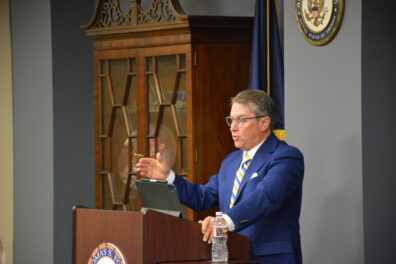
On September 25, the Foley Institute hosted Patrick Deneen, University of Notre Dame, who spoke on the challenges to liberal democracy around the world and whether the liberal regime is falling.
Professor Deneen began by characterizing what regime change entails. Though the phrase often invokes sentiments of rebellion and violence, Deneen noted that regime change is a fundamental shift in our character and way of life, not just a change in government. Deneen suggested that overthrowing the government is actually more difficult than achieving a successful fundamental shift in our way of life.
He then discussed that to achieve such a fundamental shift, there must be an overturning of the legitimacy of the ruling class and a reshaping of the ruling class itself. Tracing the features that have generated an uprising against the ruling class today, he noted that due to a fluid relationship with geography that regards borders as arbitrary and an oppositional stance to historical culture, “one should not be surprised to witness an increasing division and separation between this elite and the ordinary citizens of the nation in which that elite finds itself”.
Lastly, Professor Deneen hypothesized what a post-liberal political order might entail. He suggested we can already see the promotion of the “identification of place” that prioritizes the nation and strengthens borders, as well as the countering of hostility to historical cultural traditions with the celebration of national history. Though less evidence exists to suggest there is currently increased effort to mix the classes, this was his third prediction of a post-liberal political order.
Professor Deneen concluded his lecture by noting we are witnessing pressure from the working and lower classes for recharacterization of our nation and regime change, although it is uncertain where this pressure will lead.
Patrick Deneen is professor of political science at the University of Notre Dame. His latest book, Regime Change: Toward a Postliberal Future, was published in 2023.
October 1, 2025 – The Future of Liberal Democracy Series
Olyvia Christley: “The rise of right-wing politics in Europe”
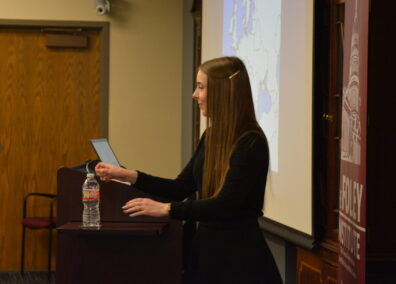
On October 1, the Foley Institute hosted Olyvia Christley, who discussed the ways in which parties of the right have risen in prominence and became integrated into governments across Europe.
Professor Christley began her talk with a discussion about Viktor Orbán, Prime Minister of Hungary, who gave a speech at the 25th Bálványos Free Summer University and Student Camp in 2014, a political workshop originally created to foster cross-border cooperation between Hungary and Romania. She noted that as each year passed, the workshop increasingly resembled a one-sided dialogue, focusing more on the political agenda of the Fidesz party. Ultimately, it was revealed that Orban used this platform in 2014 to announce the establishment of an illiberal democracy in Hungary.
Christley communicated that the Hungarian regime is not isolated, but part of a larger European story in which radical right actors are challenging sovereignty and democracy. Christley mentioned that “when we talk about the rise of right-wing politics today, what we actually mean is the ascendance of the radical right.” Christley mentioned that radical right parties are distinct from fascist parties and they do not always look like what we might expect if we only think of them in American terms.
Pivoting the discussion, Christley discussed the early 2000s, when transformations occurred within the EU (European Union). In EU member states, there was a rise in immigration, deindustrialization, and EU-driven market integration, which led to greater job insecurity in some sectors. During this period, the radical right underwent a rebranding effort, presenting itself as a viable governing alternative. This led to Austria becoming the first country to have a radical right party, followed by France, Italy, the Netherlands, and more countries over the next decade.
Christley highlighted the profound impact the 2008 financial crisis and the Syrian civil war had on fueling the radical right and creating economic instability. She then circled back to Hungary and shared that the Fidesz party rewrote the constitution in ways that systematically weakened democracy. She noted that while Hungary demonstrates how illiberal democracy can be established, Poland demonstrates how quickly a radical right party can be formed by learning from Orban. Christley explained that while the violation of EU values was tolerated, it was not until core EU policies were threatened that the EU finally acted.
Christley closed by noting that the radical right is not a fringe movement anymore, but has in fact fully embedded itself into Europe’s governments.
Olyvia Christley is assistant professor of political science at Washington State University.
October 16, 2025 – The Future of Liberal Democracy Series
Steven Hahn: “America’s illiberal past and present”
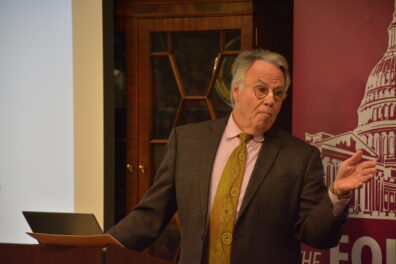
On October 16, the Foley Institute hosted Steven Hahn, who spoke on the themes contained in his recent book, Illiberal America: A History, as part of the institute’s ongoing series on the future of liberal democracy in America.
Professor Hahn opened by stating that for the last seventy-five years, American history has been taught within a liberal tradition that centers on ideas of equal rights, civil inclusiveness, and the rule of law. He noted that when Donald Trump began his first presidential campaign by violating “liberal norms,” observers failed to recognize a larger, pre-existing problem with how Americans’ views of liberalism had shifted.
Hahn touched on the idea that liberalism, which he sees as a “deep and longstanding current”, traces back to a logic tethered to the feudal or early modern world. He stressed that liberal orientation must be recognized as a continuous political force with popular appeal.
The speaker noted that a liberal democracy can vote itself into an illiberal order and cautioned that liberalism may have “run out of gas”. He suggested that those who desire democracy must think about it in a broader sense, such as an economic democracy. He stressed that without economic independence, individuals will be vulnerable to power and manipulation.
Hahn concluded by stating his intention is to de-center liberalism in order to recognize it as one of many longstanding political currents. Further, he brought attention to political movements that people often overlook, such as historical populism, cooperativism, and social democracy. To conclude, he stated that these movements offer alternative ideas on power.
Steven Hahn received his Ph.D. at Yale University and is currently professor of history at New York University. His most recent book is Illiberal America: A History.
October 23, 2025 – The Future of Liberal Democracy Series
“The radical right challenge to liberal democracy” with Matthew McManus
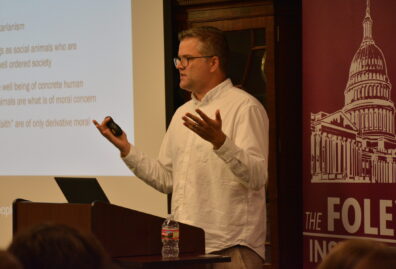
On October 23, the institute hosted Matthew McManus, Spelman College, who spoke on how today’s radical right threatens to upend the principles liberal democracy historically embraced by both liberals and conservatives.
Professor McManus began his presentation by discussing the rise of liberal politics and intellectuals. He noted that the fall of liberalism came for many in the global north in 2016, when many powerful nations around the world began to be led by illiberal leaders. Previously “hard right” views that reject basic liberal norms became mainstream and began to no longer appear far outside ideological norms.
McManus then continued his lecture by characterizing the political right as a very diverse space, as some conservative intellectualists take issue with liberal democracy rather than democracy itself, whereas others criticize society for the lack of interest in traditional aspirations towards greatness. Still, he noted, anti-liberal intellectualists are united in their conviction that “liberalism destroys everything”.
Professor McManus then went on to discuss how liberals, socialists, and liberal socialists alike can respond to the challenge of illiberal politics. McManus argued that what has led liberal democracy to this point of failure has been its unresponsiveness to the needs of ordinary citizens. As ordinary citizens have had little say in the laws that govern them, frustration and delegitimization of liberal democracy has resulted. Moving forward, McManus noted that there should be a genuine commitment to a future less restricted by the domination of politicians and the economy, and a deepening of commitments towards core liberal ideals of liberty, equality, and solidarity to all.
Mathew McManus is assistant professor of political science at Spelman College.
November 6, 2025 – The Future of Liberal Democracy Series
“Liberalism’s lost aspirations” with Samuel Moyn

On November 6, the Foley Institute hosted Samuel Moyn, who spoke on how Cold War fears of socialism led Western democratic leaders to abandon the aspirational roots of Enlightenment liberalism.
Professor Moyn began by noting the crisis of liberalism following the 2016 election. He argued “liberalism, at least in some respects, is an emancipatory doctrine that ought to be reclaimed from the liberals of the 20th century”. Moyn then situated his discussion of liberalism in its historical context and focused on the “founding liberals” including Thomas Hobbes and John Locke. While they all had somewhat different views, the founding liberals all believed that liberalism would replace old belief systems. He noted that fear was not at the center of their emotions; hope was.
He then discussed the new liberalism, which Americans referred to as progressivism. The new liberals in this country during the 20th century learned from Marxism and paved the way for Franklin Roosevelt by preserving the notion of freedom while abandoning laissez-faire policies in favor of a state that would play a role in emancipating us.
Pivoting the discussion, Moyn then focused on how “liberalism 2.0” has ruined everything. He claims that Cold War liberals “betrayed liberalism in the name of saving it”. The Cold War liberals regarded John Locke as the founder of liberalism, as they believed the point of liberalism is liberty from interference. Cold War liberals believed that they should be left alone, especially by the state. He suggested that during the Cold War, liberalism deviated from its founding principles.
Moyn concluded by addressing where we currently stand. He argued that neoliberal economics, which began in the 1970s, has left people economically positioned to be skeptical of liberals. However, it is essential not only to focus on economics. Moyn claimed that individuals have been voting for Trump as a protest against the elites who have “given Americans little sense that the future is bright for them.” He closed by asserting that this period of debate on liberalism and liberalism on the brink in the United States will lead to its renewal.
Samuel Moyn is the Kent Professor of Law and History at Yale University. His latest book is Liberalism against Itself: Cold War Intellectuals and the Making of Our Times, published in 2023.
November 12, 2025 – The Future of Liberal Democracy Series
“Unequal access: the politics of healthcare access in America” with Emily Parker

On November 12, the Foley Institute hosted Emily Parker, Rutgers University, who spoke on her research regarding government policy shaping access to health care for low-income Americans. Parker discussed the history and political significance of community health center programs, a crucial but often overlooked component of the U.S. healthcare safety net.
Parker opened the discussion by noting the program’s origins in 1965 as part of the War on Poverty, noting that its goals were deeply rooted in social justice and civil rights values and that it aimed to provide free health care. She then highlighted that despite serving over 33 million Americans today, the program operates as part of the “hidden or submerged state” where patients often interact with the service without realizing its federal backing. Parker then expressed that the program’s uncommon bipartisan support, promoted by presidents from George W. Bush to Barack Obama, was achieved by framing the government intervention as correcting a fundamental market failure in medicine, thereby allowing it to sidestep the “deservingness debates” that continually plague programs like Medicaid.
The speaker then stressed a critical juncture in 1996, when a welfare reform separated health centers from other safety net policies by maintaining eligibility for immigrations, making them one of the country’s only immigrant-inclusive national institutes. Parker’s research showed the real-world impact of this inclusion, finding that health centers reduce the foreign-born mortality rate in countries where they are located. She concluded that its immigrant-inclusive status is currently under threat. She argued that the political processes that affected these policies have serious population-level consequences and called for a broader national conversation about securing the right to health care for all.
Emily Parker is assistant professor at the Edward J. Bloustein School of Planning and Public Policy at Rutgers University. She obtained her Ph.D. in Policy Analysis and Management from Cornell University.
December 3, 2025 – The Future of Liberal Democracy Series
“Autocrats vs. democrats: China, Russia, America, and the new global disorder with Michael McFaul”
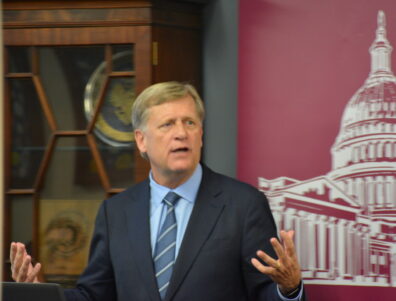
On December 3, the Foley Institute hosted Michael McFaul of Stanford University, who compared Cold War dynamics between the U.S. and the Soviet Union to the current global situation involving the U.S., Russia, and China.
Dr. McFaul spoke on the three factors that have driven this great competition. He noted that every competition starts with power, as powerful countries tend to compete. Secondly, regime type also matters, especially in a world that is experiencing heightened tensions between autocracies and democracies throughout the world. Lastly, he argued that leaders themselves are important factors driving a great power competition, highlighting that autocrats are always threatened by democratic leaders and democratic movements in other nations.
His talk then transitioned into a discussion on the similarities and differences between the Cold War and great power competition today. Some similarities in the relationship between Russia and the U.S. today and that of thirty years ago include the nuclear superpower capabilities and ideological competition. However, he suggested, the biggest difference now is that the ideological competition mainly exists within countries rather than between them.
McFaul then noted the lessons we ought to take from the Cold War. He warned against repeating our mistakes, such as threat overestimation, overreach, and embracement of dictators. Further, he encouraged the U.S. to emulate their successes, such as promoting democracy and establishing soft power with USAID. He concluded by claiming that there are hopes for the future, as a united democratic world retains immense power and the Chinese economy is currently slowing. Noting this is not the first era of democracy versus autocracy, McFaul mentioned he is betting on the side of democracy.
Michael McFaul, former Ambassador to Russia, is professor of International Studies in the Department of Political Science at Stanford University. His most recent book is Autocrats vs. democrats: China, Russia, America, and the new global disorder.