Spring 2025
Use the key word search function  at the left of this page to find specific events
February 12
“Can beer save democracy?”
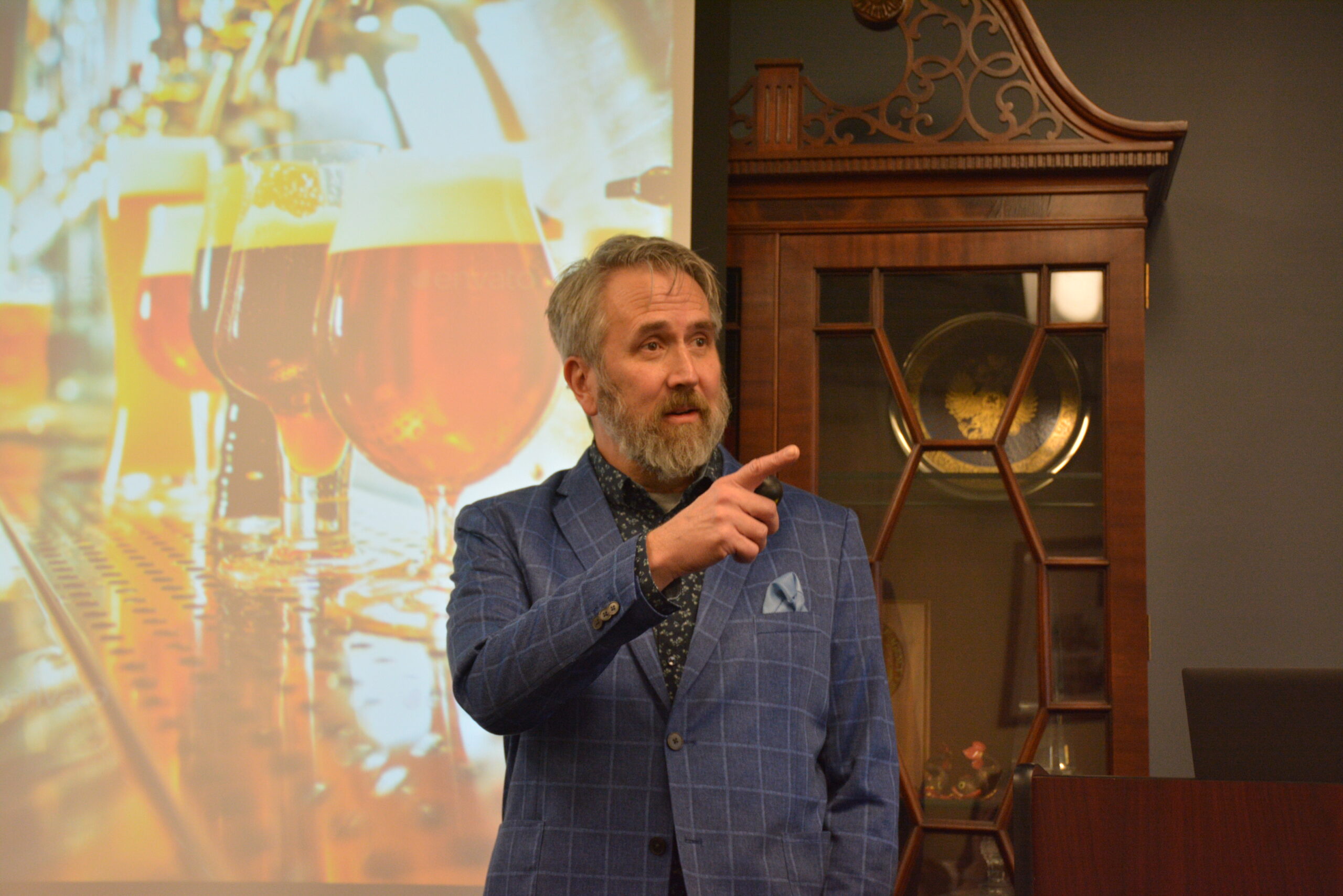
On February 12, the Foley Institute hosted WSU’s Michael Goldsby, who spoke on how the damaging effects of increasing polarization and lack of common ground between citizens may be mitigated by sharing a beverage.
Professor Goldby opened his presentation by addressing the history of beer among both civilization and American forefathers. Quoting Lincoln, Dr. Goldsby mentioned the former President’s belief that the American people, when provided with truth and beer, have the potential to meet any challenge. He then proceeded to discuss the virtues of American democracy that make it worth saving, such as the ability to register both content or discontent with respect to policies through elections, the rule of law, and the reverence for basic rights. Goldsby noted how equity is the goal which democracy aims for, and that like democracy, beer is all equal.
He suggested that the ‘marketplace’, where we can enjoy a wide variety of pursuits, is crucial to democracy. However, the lack of common ground that is required by a true public square has made agreement on fundamental democratic principles difficult. Professor Goldsby suggested that current extremely high levels of polarization is the result of social media, given that its reward structure embraces and encourages inflammatory language, thus contributing to a lack of common ground.
Goldsby suggested that sharing a beverage can be a solution to the increasing hyperpolarization that is threatening our democratic institutions. Sharing a beverage promotes civility due to the nature of in-person dialogue. He noted how a seemingly adverse aspect of in-person dialogue, lack of broad engagement, is actually advantageous because it can foster revitalized interest in local politics. He concluded by noting how conversing over any beverage can be just as effective as beer.
Michael Goldsby is an Associate Professor of Philosophy in the school of Politics, Philosophy, and Public Affairs at Washington State University.

February 24
“Defending Washington”
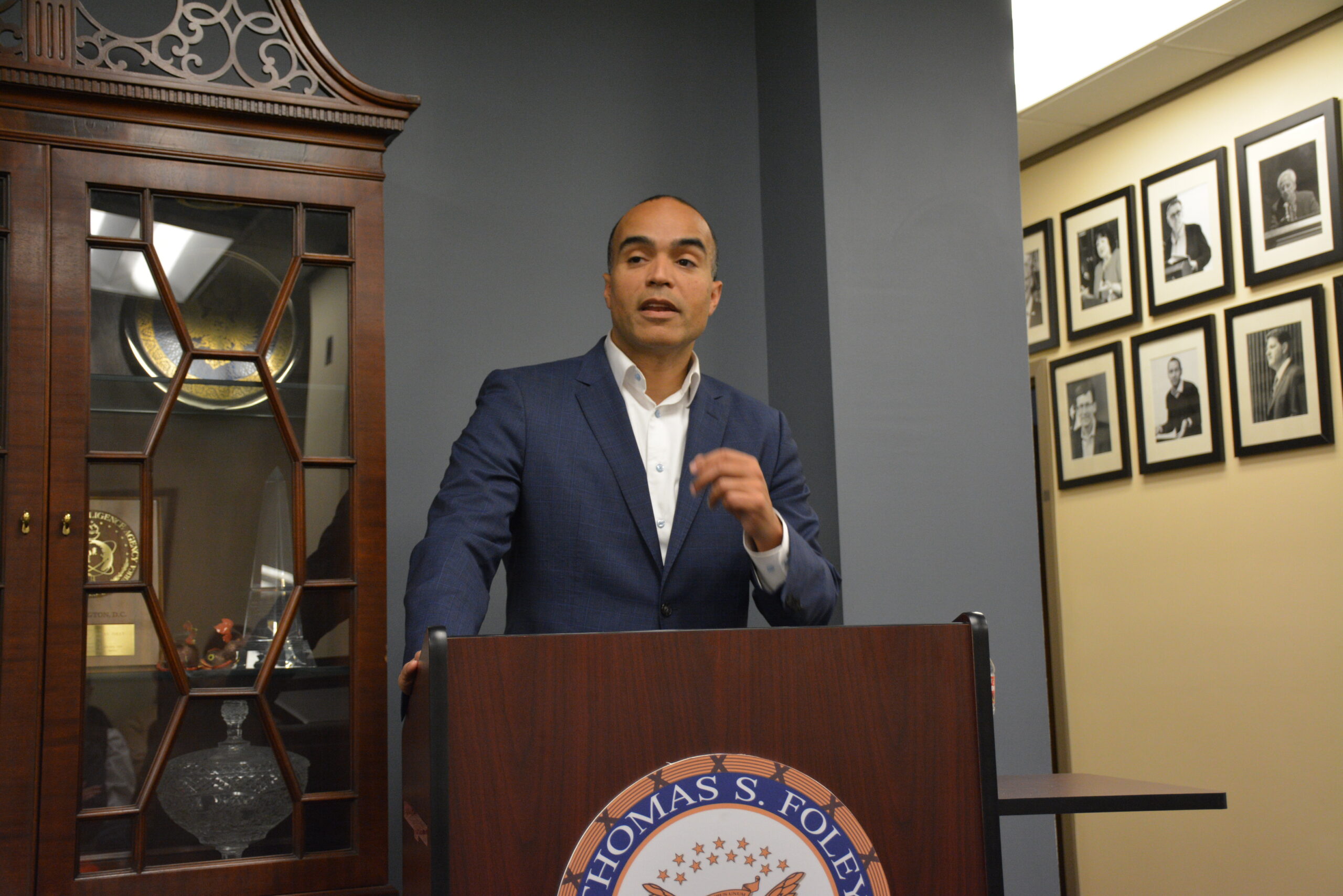
On February 24, the Foley Institute hosted Nick Brown, the Washington State Attorney General, who discussed the ongoing litigation against the Trump Administration and additional responsibilities of his office.
His first month in office has been marked by intense litigation against executive orders signed by President Trump. Brown asserts that Washington is leading two legal challenges, one against the executive order restricting gender affirming care and another against the executive order restricting birthright citizenship protections. In addition, Washington is joining other states participating in three lawsuits concerning the federal financial assistance freeze, foreign aid payments, and Privacy Act violations. Brown discussed the commitment of his team to holding the president accountable and assuring that the rights of people in Washington State are upheld.
Brown then fielded questions from the audience, touching on Supreme Court decisions, mass layoffs in federal agencies, and the state budget deficit. He discussed the conditions in place for Washington to join a suit and how the Attorney General’s Office selects and prioritizes cases. The discussion concluded with Brown assuring that his team intends to keep the rights of Washingtonians at the heart of their practice and to uphold the constitution against unjust actors.
Elected to office in November of 2024, Nick Brown is Washington State’s 19th Attorney General. He obtained his JD from Harvard University in 2002.
February 27
“Defamation, disinformation, and democracy”
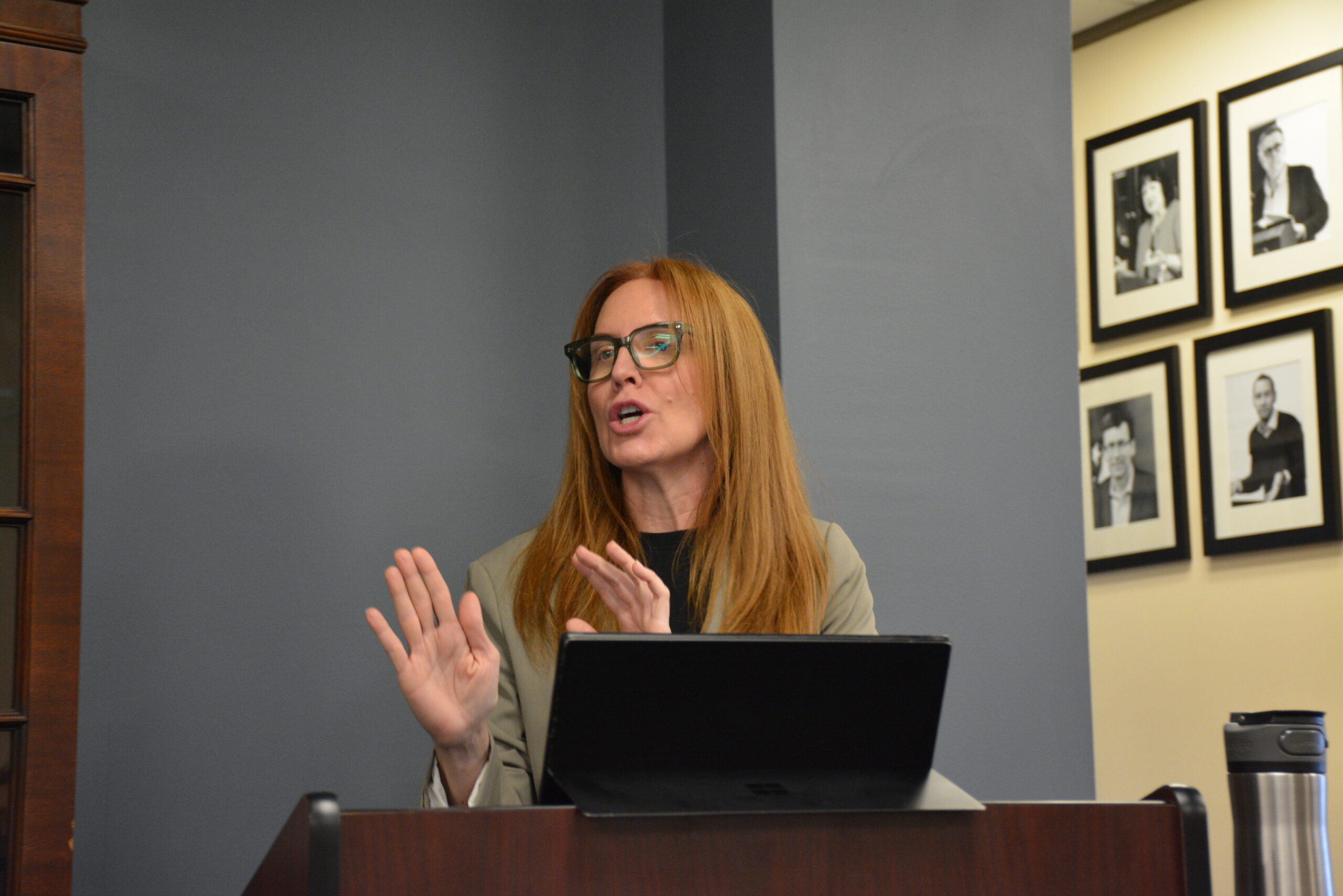
On February 27, the Foley Institute hosted RonNell Andersen Jones, who spoke on the proposed reconsiderations of New York Times Co. v. Sullivan (1964), a Supreme Court Case that has formed the basis of judicial decision-making regarding defamation, disinformation, and democracy. The Sullivan case arose after the New York Times (NYT) was sued by the Montgomery police commissioner for defamation following minor, and largely inconsequential, falsehoods in the reporting of police brutality during Civil Rights protests. The United States Supreme Court unanimously reached a precedent setting decision in favor of the NYT. The court agreed that the right to criticize public officials is a freedom protected at the core of the First Amendment and conceded that some falsehoods are inevitable in this free space.
Andersen Jones continued her discussion by acknowledging that the view advocating for greater freedom for public officials to bring defamation suits has recently gained traction. Supporters argue that in doing so, there would be more space for combatting the spread of disinformation and propaganda in our new media environment. However, Andersen Jones maintained that there is a disconnect between the proposed solution of scaling back Sullivan and the actual issue of disinformation. The speaker explained how disinformation often fails to meet the criteria of defamation because, although it contains lies, it typically lacks reputational damage.
The speaker then argued how this proposed solution will not only fail to adequately address the problem of disinformation, but it may actively make matters worse. Unwinding Sullivan allows news organizations to become the likely target of defamation lawsuits, which are costly and capable of wiping out smaller media companies. Even in an age of heightened partisanship in news organizations, the press function is geared towards combatting lies and producing strong journalism. Reevaluating Sullivan allows powerful people to inflict harm on the space required to engage in public discussion.
Andersen Jones concluded her lecture by discussing how the outcomes of several recent high-profile defamation lawsuits have pointed to this change in constitutional thought regarding the Sullivan protections. Instances, such as President Trump’s defamation lawsuit against ABC News, where Sullivan arguments could have easily been made in court but are instead being ignored, indicate that the weaponization of defamation lawsuits is becoming far easier. While there is a pressing need to better defend against disinformation, reconsidering the Sullivan precedent would not better protect democracy, but would instead harm it.
Professor RonNell Andersen Jones is a University Distinguished Professor and the Lee E. Teitelbaum Chair in Law at the University of Utah.
March 4
“Informing Democracy?”
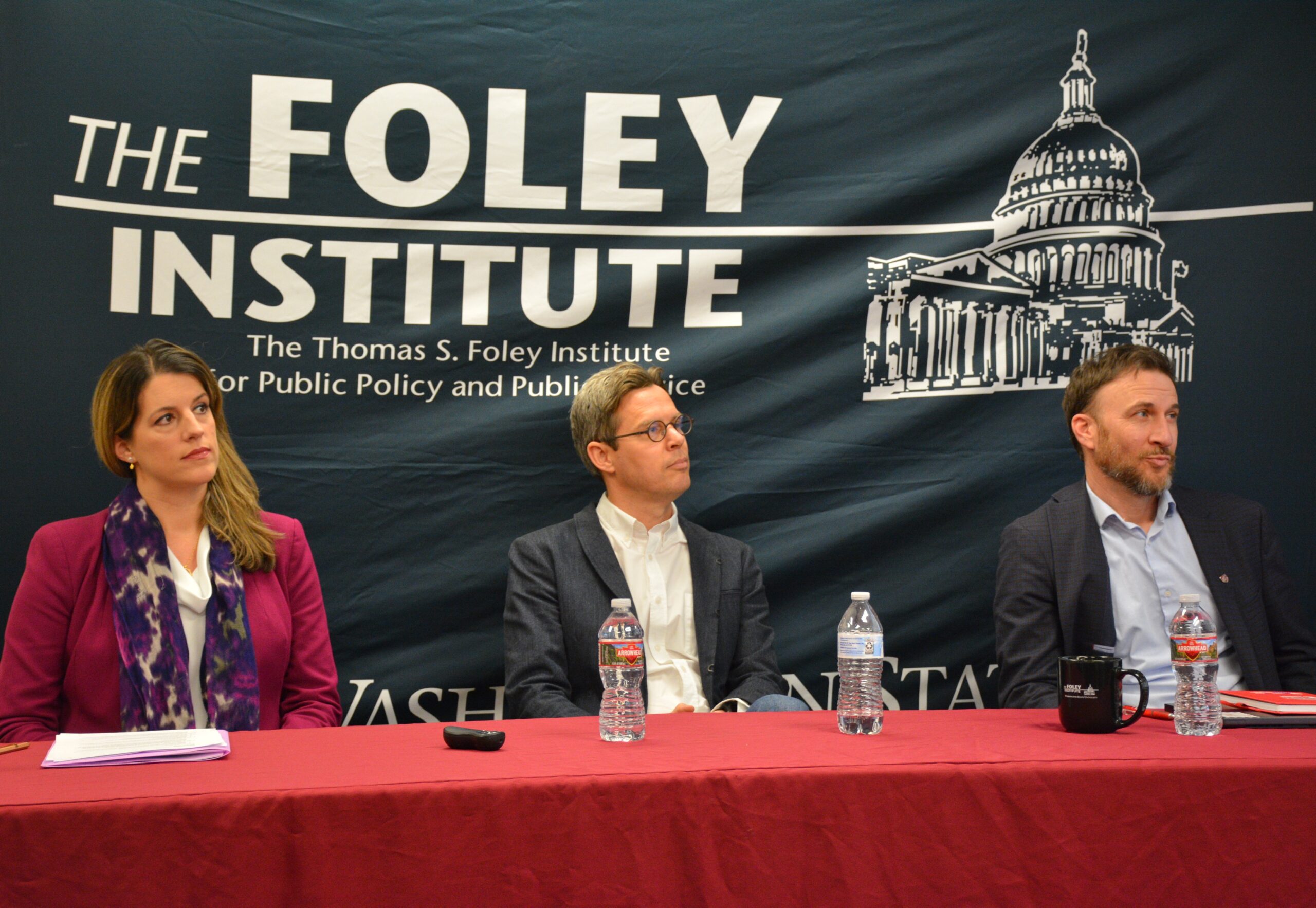
On March 4, 2025, the institute and the Edward R. Murrow College of Communication presented the 2025 Media and Politics Symposium on the declining media presence in Olympia covering state politics.
Jennifer Henrichsen from WSU provided an overview of her team’s research on the local news ecosystem in Washington, which found the state was not immune to the challenges facing news outlets, with rural areas especially susceptible to a loss of local news outlets and reporters.
Matthew Powers from the University of Washington focused his comments on Olympia. His analysis of media in Olympia over the past several years found that the news landscape had transformed, with the press corps becoming younger and less male-dominated. At the same time, there had been a shift in content toward more human interest and stories such as environmental, hot button cultural issues, and less “turn of the screw” investigative reporting.
Finally, Benjamin Shors, from the Murrow College, responded that there is more availability of free political news than ever before, but that the bigger issue is trying to encourage the public to engage with it. He noted the general lack of trust in the media and suggested the need for more investment in news and journalism infrastructure to regain that trust.
March 17
“Counting on the youth vote?”
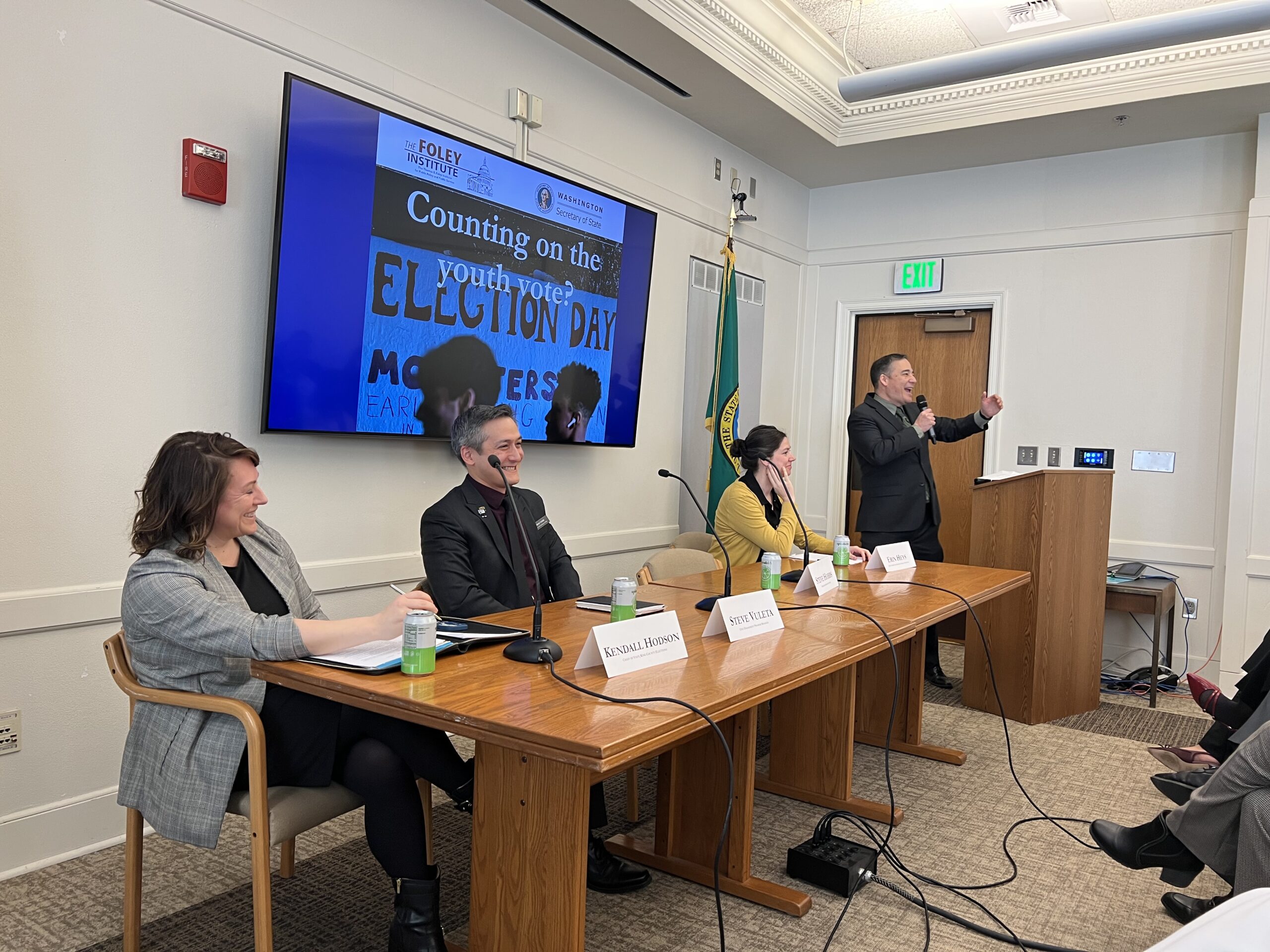
On March 17, the Foley Institute held our annual symposium in collaboration with the Washington Secretary of State’s office in Olympia, Washington. This year’s event focused on youth voting, with Secretary of State Steve Hobbs facilitating a discussion between Erin Heys, UC Berkeley, Steve Vuleta, WA Secretary of State’s Office, and Kendall Hodson, King County Elections Office.
The discussion began with Erin Heys discussing broader trends in youth voting. She notes that the 18-24 age group has consistently been the least likely to vote, with turnout also decreasing over time. Multiple theories coexist to explain this phenomenon, such as the nature of transitory life periods, greater incentives to vote as one ages, and generational experiences on broader voting collectives. These conditions result in young people being the least likely to turn out in the polls.
The panel then shifted to Steve Vuleta overviewing the role of the Civic Engagement Program in Washington State, which is meant to bridge the gap between state government and those who may experience barriers in engaging with our democracy. He emphasized that democracy functions best when all people are directly involved and that there are many avenues to civic engagement, such as educational and community involvement programs. Civic engagement programs are an effective way to get young people comfortable in our political systems, making them more likely to remain engaged in the future.
The symposium concluded with Kendall Hodson discussing methods of reaching young voters through her experience on the ground in King County. She discussed ways in which her office attempts to increase civic engagement in the youth, primarily through the classroom environment. Their office also gives grants to community outreach programs, particularly those focused on youth voting and engagement.
March 28
“The Ukraine crisis”
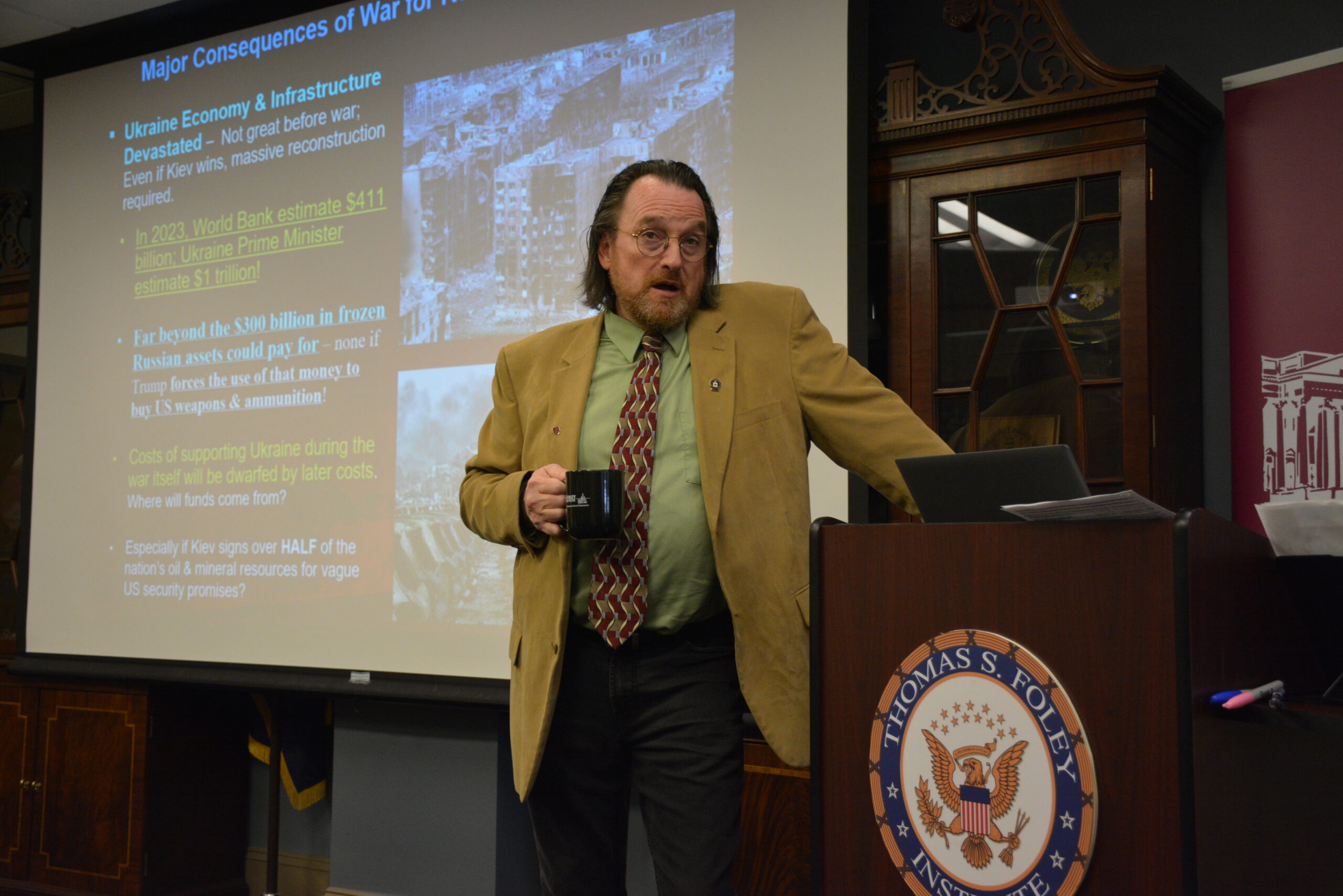
On March 28th, The Foley Institute hosted WSU’s Thomas Preston in a discussion around the Ukraine crisis and the post-WWII world order.
Dr. Preston began by discussing the post-WWII liberal world order that was constructed by the United States, which is now being abandoned by the Trump administration in favor of a Hobbesian, realist approach to foreign policy. He also cites the empty promises made by the U.S. with regards to Ukrainian security guarantees, specifically the 1994 decision for Ukraine to return their nuclear weapons to Russia. Such decisions exemplify the U.S.’s waning commitments to maintaining the liberal world order, which is beginning to fracture. Preston also cited NATO expansion into Eastern Europe as an existential threat from Putin’s point of view, which contributed to the decision to invade in 2022.
Preston proceeded to talk about the situation on the ground in Ukraine. He states that Western military aid, particularly missile systems, have been vital in enabling the Ukrainian defense against a superior Russian military. Aid has slowed over the past few years, however, severely limiting Ukrainian capabilities, the effects of which have been seen on the battlefield. Much of the difficulty in delivering aid has come from American domestic politics, specifically the Republican opposition to Ukrainian assistance, which has become increasingly overt over time.
Preston described the change in American foreign policy as a “seismic shift” in approach, the likes of which is unprecedented among past presidents. He claims that the “isolationist” label that has been commonly attributed to Trump’s foreign policy is misleading, as it is more accurately one of authoritarian, nationalist populism that is only concerned with increasing America’s power. The result of such an approach is an erosion of our reputation among allies and a move away from trust in American leadership.
Preston concluded by foreshadowing potential consequences for the current U.S. approach. In assuming a Ukrainian loss, he foresees an emboldened Russia moving forward, with further territorial aggression likely. A democratic Ukraine would cease to exist, with the possibility for the state to be absorbed completely into the Russian empire. It’s also possible that China will see the weak U.S. response to Ukraine as an incentive to move on Taiwan and the South China Sea. Confidence in American security guarantees will also be severely undermined moving forward.
Thomas Preston is C. O. Johnson Distinguished Professor of Political Science at Washington State University.
April 21
“The fentanyl crisis and college campuses”
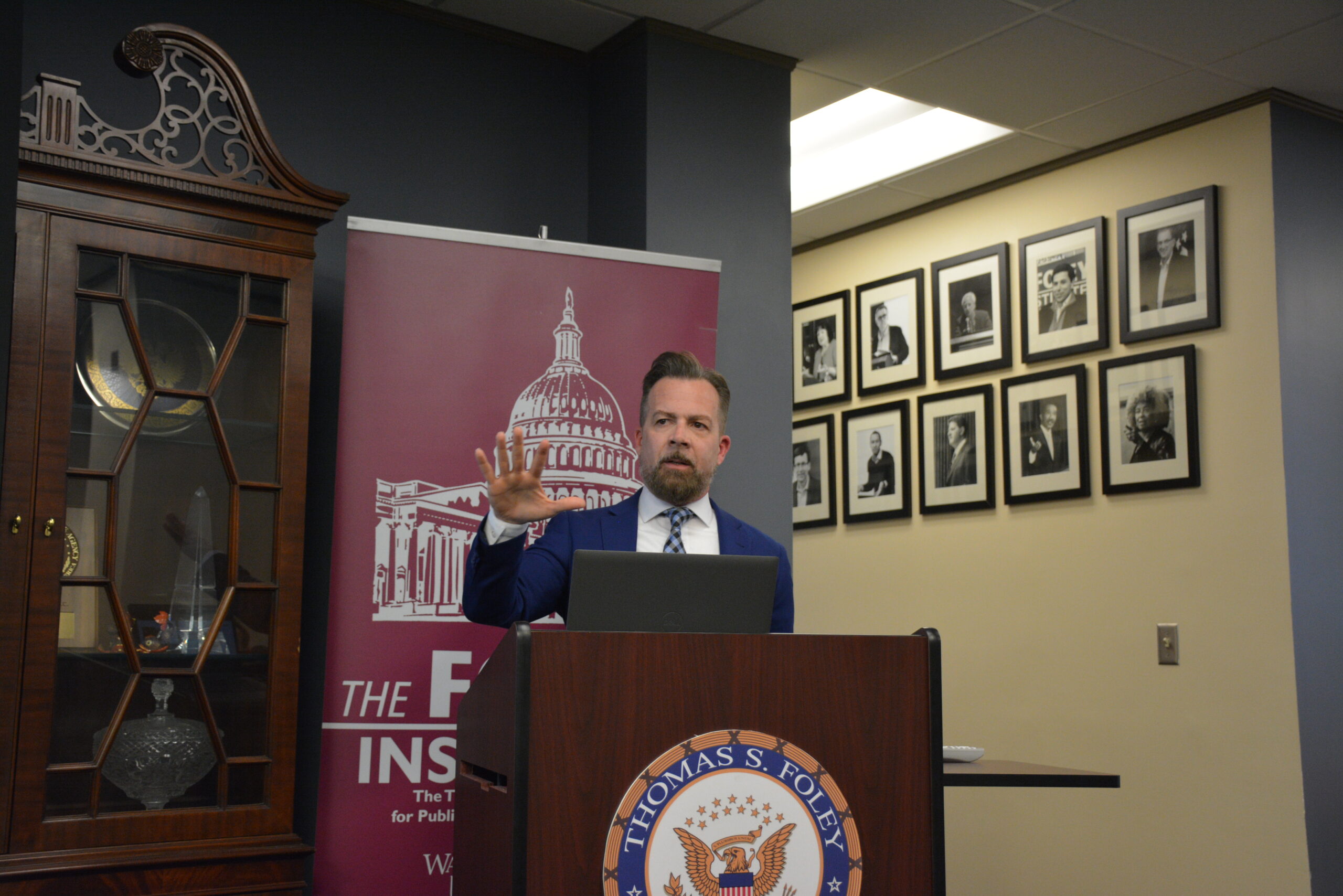
On April 21, the Foley Institute hosted Boston University’s Noel Vest, who spoke on his research regarding the fentanyl crisis on college campuses.
Vest discussed how, following the death of a student at Stanford University, student-level advocacy inspired him to pursue further research on fentanyl-related deaths at universities. Vest noted that the college-aged population is a particularly vulnerable demographic to opioid misuse and overdose. Still, universities are well equipped to engage in upstream prevention strategies as there are many existing wellbeing programs and trainings already available to students across the country.
His research on the subject focuses on examining the limited existing research in the field, tracking related policy, collecting data on opioid overdose knowledge, and analyzing the perceptions of higher education leaders on opioid overdose prevention policy. The major takeaways of Vest’s research are that most existing studies focus on prevention, a large majority of college students are willing to intervene in an overdose despite only a small percentage knowing how to administer naloxone, and that phased implementation of opioid prevention programs is key to overcoming the barriers to implementation.
Vest concluded by examining the future direction of opioid overdose research and policy. He highlighted how Washington state is leading the way for increased policy regarding harm reduction and overdose prevention.
Noel Vest is an Assistant Professor at Boston University. He advocates for public policy relating to substance use disorder recovery and prison reentry. He received his Ph.D. from Washington State University.